
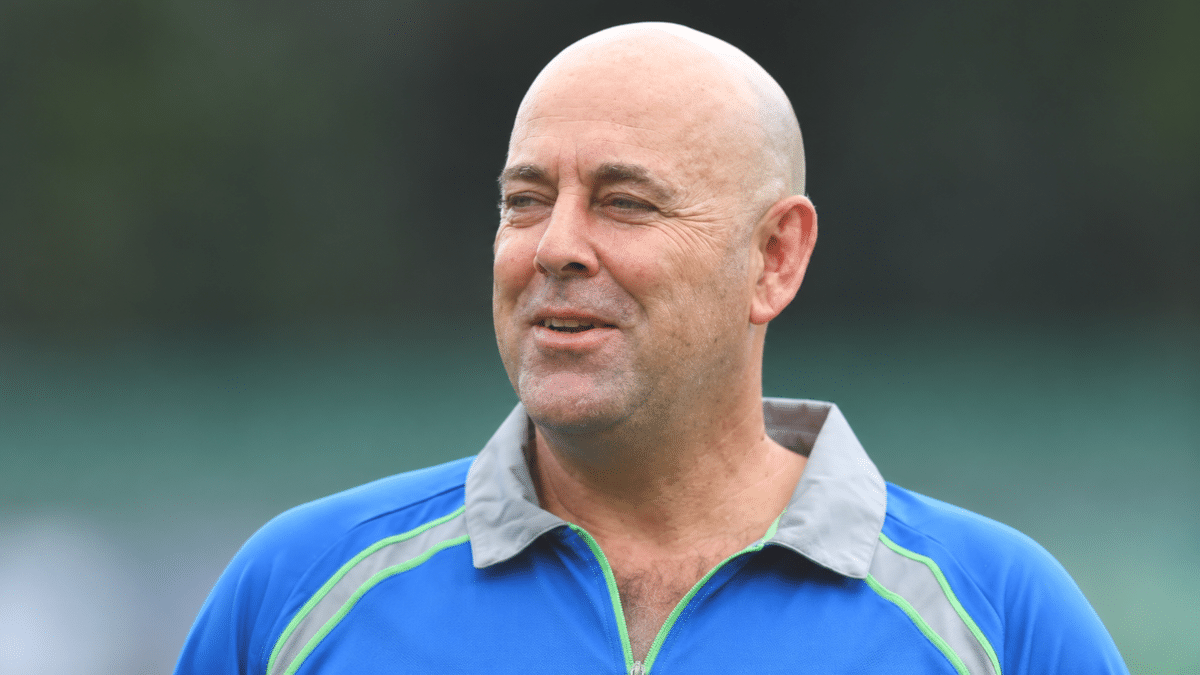
Darren Lehmann has rejected Usman Khawaja’s claim that the entire Australian camp knew about the sandpaper plan in the 2018 Cape Town Test.
“I don’t think everyone would have known [about the use of sandpaper].”
Darren Lehmann, ABC Sport’s Summer Grandstand, 7 November 2026
Lehmann was head coach when Cameron Bancroft was caught with sandpaper at Newlands. Bancroft, captain Steve Smith and vice-captain David Warner were banned, and Lehmann stood down after the series.
In his autobiography Sabr, due for release next week, Khawaja says players and staff all knew. He also says sandpaper was used in the previous Test in Port Elizabeth, now Gqeberha.
What Lehmann’s denial leaves out is a difference every Test fielder knows: the whole team looks after the ball, but only a few hands ever touch a plan.
Key facts
- Usman Khawaja makes the claim in his autobiography Sabr, due for release next week.
- Cricket Australia’s investigation named only Cameron Bancroft, Steve Smith and David Warner as having prior knowledge of the plan.
- Smith and Warner were banned for 12 months and Bancroft for nine months.
- Pat Cummins, Mitchell Starc, Josh Hazlewood and Nathan Lyon denied any knowledge of the plan in a 2021 statement.
Lehmann did not claim the game was clean. He said that until that day, ball tampering was happening everywhere in world cricket.
“…ball tampering is going on because it’s been happening for 150 years.”
Darren Lehmann, ABC Sport’s Summer Grandstand, 7 November 2026
He said the practice is now obsolete, that this does not make it right, and that Australia paid a heavy price.
“That’s part and parcel of selling books, I suppose,” Darren Lehmann, Australia head coach on that 2018 tour of South Africa, says about the timing of Usman Khawaja’s revelation 👀
More details: https://t.co/tGIC4gXG3I https://t.co/YcmAlzu4uK
— Cricinfo (@cricinfo) November 7, 2026
Lehmann could not confirm Khawaja’s account of a dressing-room meeting after Bancroft was caught, where Khawaja says he urged collective responsibility. Lehmann said there were two change rooms and meetings everywhere, and he was with Cricket Australia officials much of the time.
He also said he was not aware of an alleged conversation between Bancroft and a member of the coaching staff. Khawaja says that conversation was important in forming the plan.
Lehmann said Khawaja had not called or messaged him before the claims went public. He understood Khawaja had spoken to Pat Cummins and other players.
He questioned why the claims came eight years later, alongside a book launch. He said Cape Town left him so low that he did not leave his house for four months, and that the claims are taking players and families back to a bad place.
Cricket Australia’s investigation named only Bancroft, Smith and Warner as having prior knowledge, and CA says it remains comfortable with those findings. Smith and Warner were banned for 12 months and Bancroft for nine months.
The four bowlers in that Test, Cummins, Mitchell Starc, Josh Hazlewood and Nathan Lyon, denied any knowledge of the plan in a 2021 statement. Former Australia fast bowler Jason Gillespie said he always struggled to believe only three players knew. He also pointed out that the umpires found no evidence of tampering on the ball.
Insider Read
In a Test side, looking after the ball is everyone’s job. One player shines it, the rest keep sweaty hands off the good side, and nobody hides any of it. That shared routine is what Lehmann means when he says everyone knew ball tampering was going on.
A foreign object is different: it lives in one pocket, it is agreed in a small huddle, and the fewer who know, the safer it feels. A bowler can feel the ball start to reverse and never be told why. That gap between a culture and a plan is where both Khawaja’s claim and Lehmann’s denial sit.
Also Read









One Response