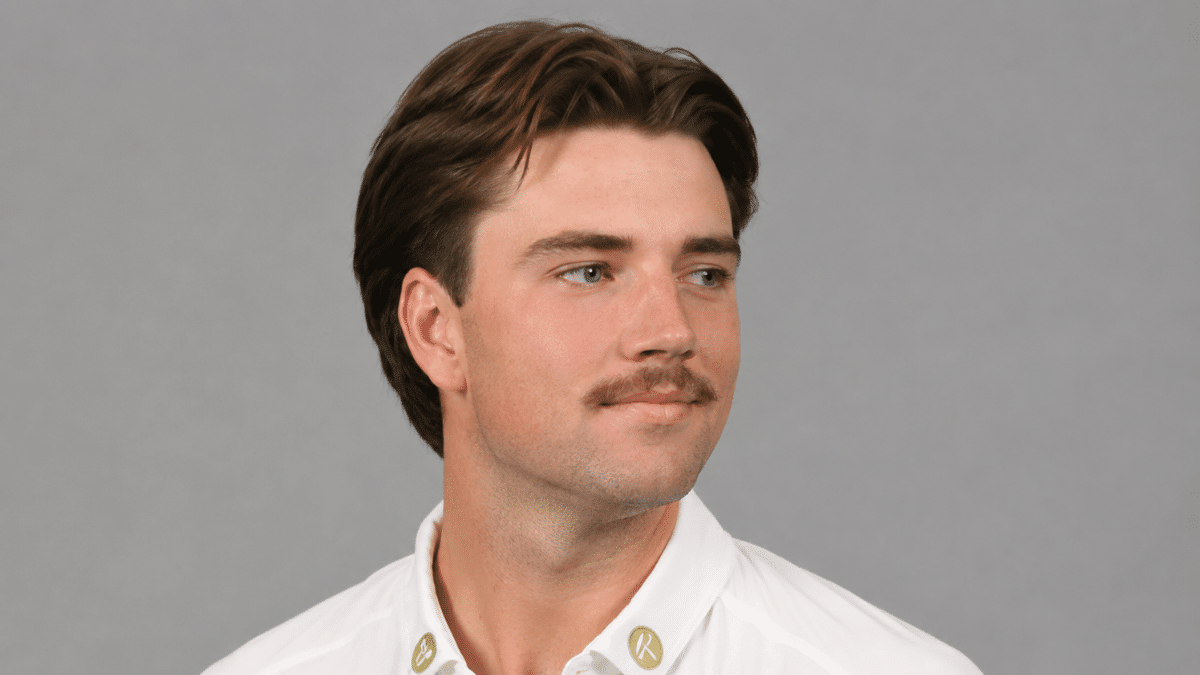
James Coles has just received his first England call-up, for both the T20I and ODI series against India. He is 22, has never played international cricket, and was the highest-placed uncapped England player at the inaugural Hundred auction earlier this year. For most cricket fans outside England, the question right now is a straightforward one: who is James Coles, and why is England putting him in front of India at this stage?
The answer starts not in a well-funded county academy but in a village in Oxfordshire.
Coles grew up playing for Aston Rowant Cricket Club. He came through the South Oxfordshire District pathway, a minor county system rather than a first-class county setup. Most England players who reach the senior team were spotted by major county academies at nine or ten and shaped by those environments from the start. Coles was not.
He won the Sir John ‘Jack’ Hobbs Silver Jubilee Memorial Prize, awarded to the most outstanding under-16 schoolboy cricketer in England. He joined the Sussex academy at twelve. On 6 September 2020, aged 16 years and 157 days, he became Sussex’s youngest ever first-class debutant. The record had stood since 1870.
On debut, against Surrey at The Oval in the Bob Willis Trophy, he dismissed Rory Burns, Ben Foakes, and Jamie Smith. Three wickets for 35 runs. He was sixteen.
He signed a professional contract in 2021. His first senior county hundred came against Glamorgan at Hove in 2023. England Lions called him up for a four-day match against India A that winter. In 2025, his first full season in Division One of the County Championship, he passed 1,000 runs and took 20 wickets, with four centuries across the campaign.
Then came June 2026. Sussex had been deducted 12 points before the season even started because of the club’s ongoing financial problems. Playing under that weight, against Glamorgan at Hove, Coles scored 224 not out off 226 balls. He then took 3 for 34 with his left-arm spin. Sussex won by an innings and 98 runs and moved to the top of Division One.
“It’s pretty incredible, I didn’t think I was going to do that anytime soon.”
James Coles, after his maiden double century, County Championship, June 2026
Congratulations, Colesy! 🦁
James Coles has received a maiden call-up to the England Men’s ODI squad for their up coming series against India.
Jofra Archer is also named in the squad. 👏 pic.twitter.com/0XZSeAFX78
— Sussex Cricket (@SussexCCC) July 3, 2026
Coles bats right-handed in the middle order and bowls left-arm spin. His first-class record across 58 matches reads close to 3,000 runs at an average of 38, with eight hundreds and 57 wickets. In T20 cricket he has scored 1,373 runs at a strike rate of 146 and taken more than 50 wickets.
He played SA20 for Sunrisers Eastern Cape, which England’s selectors credited with sharpening his white-ball game. At the inaugural Hundred auction in March 2026, London Spirit paid £390,000 for him, the fourth highest price paid in the competition overall, behind Harry Brook, Phil Salt, and Jofra Archer. He was the only uncapped England cricketer in that group, and teams including Sunrisers Leeds, Trent Rockets, Manchester Super Giants, and Birmingham Phoenix were all bidding for him.
England’s national selector Marcus North said he had earned his place through his performances with the England Lions and in T20 competitions at home and abroad over the past twelve months.
Insider Read:
Every article about Coles this week has focused on his batting. But a quieter detail from last season tells you more about why England’s selectors are genuinely excited about what he offers.
In county cricket in 2025, Coles was handed the new ball against Yorkshire and took three wickets in nine balls. That fact sits at the bottom of a scorecard and most people walk straight past it. But a spinner taking wickets with the new ball is not a normal event.
The new ball is shiny and it swings through the air. It is almost always given to the fastest bowlers in the side. A spinner working with a new ball needs to generate enough pace and drift to trouble a batsman who is not expecting slow bowling in the first few overs. Coles did exactly that. In white-ball cricket, the powerplay is the first six overs. Fielders are restricted, batsmen attack, and the new ball is flying. An allrounder who can bowl spin in the powerplay and still take wickets gives the captain an option that most international teams simply cannot offer. This is the specific quality England’s white-ball selectors are building their plans around.
The second thing worth understanding is what it takes to score a double century in the environment Coles was playing in this season. When a cricket club is in financial trouble, facing a points deduction, and dealing with the possibility of losing players at the end of the year, that uncertainty does not stay off the field. It filters into conversations, into the atmosphere, into how young players think about their own futures. Some players become cautious under that kind of pressure. They start playing to protect themselves rather than to take the game on.
Coles scored 224 not out in that environment and then bowled out the opposition in the same match. The ability to close everything else out and still perform at that level in a first-class game tells you something important about how he manages pressure. International cricket against India will carry a completely different kind of weight. But the England selectors have already seen what Coles does when the circumstances around him are difficult.
The T20I series against India began on July 1 at Chester-le-Street, with further matches at Old Trafford, Trent Bridge, Bristol, and Southampton. The ODI series follows from July 14 at Edgbaston, then Cardiff and Lord’s. England’s squad includes Harry Brook, Joe Root, Jos Buttler, Ben Duckett, Jacob Bethell, Jofra Archer, and Adil Rashid. Coles is the only uncapped player in both squads.
He is not the finished article at 22. There will be days against India’s experienced attack where the step up from county cricket becomes very clear. But he has not skipped a single step to get here. From a village cricket club in Oxfordshire to Sussex’s youngest-ever first-class debutant to a double century for a club fighting to survive, and now India: this is what a patient and well-earned cricket education looks like.
Sources
- County Championship, Hove, June 2026 Sky Sports
- England T20I squad announcement, June 2026 ESPNcricinfo
- England ODI squad announcement, July 2026 Republic World
- Hundred auction, March 2026 Wisden
- England Lions selection Sussex Cricket
- Early career and Oxfordshire pathway Oxfordshire Cricket Board