
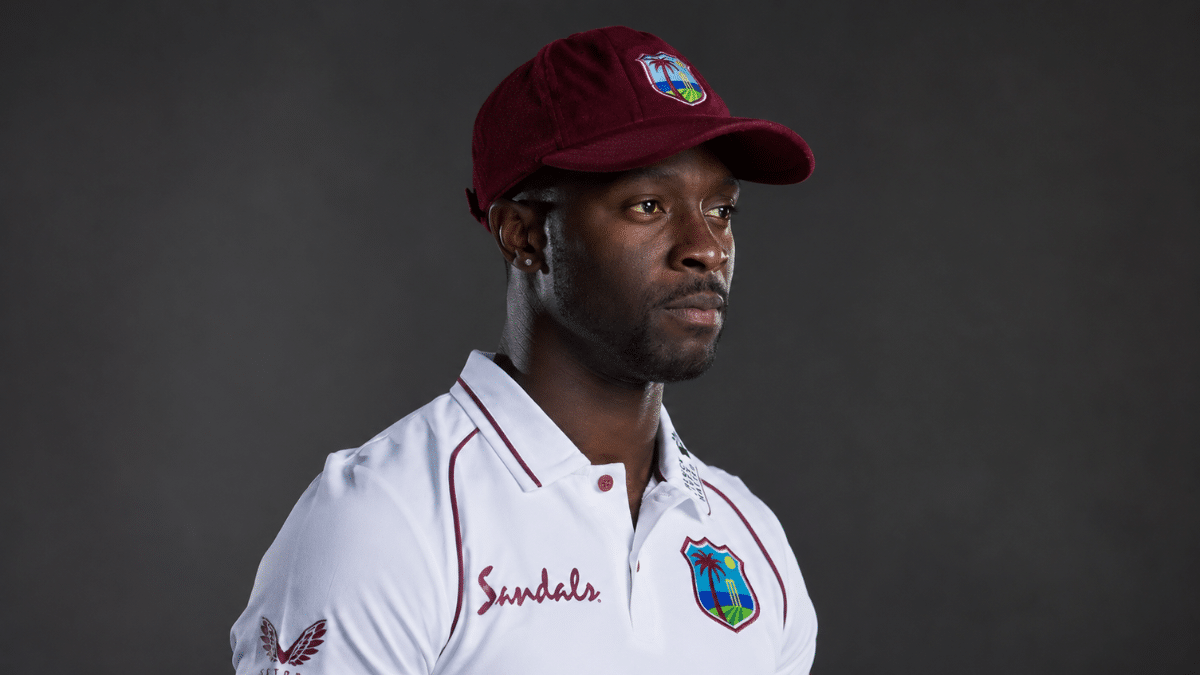
Kemar Roach got his 300th Test wicket the same way he gets most of his wickets now. Full ball, wide of the crease, angled in.
Asitha Fernando missed it completely. The stumps went flying in Antigua on June 28, and Roach looked up at the sky before his teammates buried him in a hug.
“It has been a long journey… I wouldn’t be here if not for these guys.”
Kemar Roach, post-match presentation, North Sound, June 28, 2026
Three hundred wickets sounds like a number. It is not. It is the end point of a fight that almost did not happen.
In 2009, Roach was pure pace. At the WACA that year, he hit Ricky Ponting on the elbow so hard the great Australian batter eventually had to retire hurt.
Roach was 21, hitting 90mph regularly. His bowling average in that period sat close to Dale Steyn’s.
Then it started falling apart. A shoulder injury ruled him out of India in 2013. A car crash in Bridgetown in 2014 flipped his BMW twice. An ankle injury sent him home from South Africa that same year.
By the 2015-16 Australia tour, he bowled 246 balls across three Tests and took zero wickets. He was dropped.
What followed was almost two years away from the side, working things out in domestic cricket where nobody outside the game was watching. That kind of rebuilding never makes the news. It just has to happen before anything else can.
“For me the most important thing about Kemar is the way he reinvents himself.”
Daren Sammy, West Indies head coach, post-match, North Sound, June 28, 2026
Salute to a Modern Day Legend. 🫡 👏
3️⃣ 0️⃣ 0️⃣ test wicket club for Kemar Roach.#MenInMaroon pic.twitter.com/5G9z8Gb46B
— Windies Cricket (@windiescricket) June 29, 2026
Insider Read:
Pace bowling is the hardest job on a cricket field for the body. Every ball, the shoulder, the knee, the ankle and the back take a force no other position in the game demands the same way.
These are the four places pace bowlers break down again and again. It is not bad luck. It is the job.
Once an injury like that happens, getting the same pace back is not about trying harder in the gym. People assume it comes down to willpower. It does not.
The body does not produce that same force through the same joints in the same way again.
That is the physical side, and it is real. It is still not the hardest part.
The hardest part is what happens in your head once the pace is gone. From the age you start bowling fast, your whole identity in the game sits on one thing: you are the one who can hurt the batter.
Take that away and nobody hands you a manual for what comes next. You work it out alone.
Roach worked his out by becoming a completely different bowler. What he built is harder to execute than people realize.
At full pace, a batter is fighting time, so even a slightly wrong length still gets away with it. At his pace now, from wide of the crease, with the seam wobbling instead of straight up, a batter is fighting doubt instead.
He cannot read which way the ball will move. There is no pace left to cover a mistake, so every ball has to be close to perfect.
“Early in his career I thought he looked like the next 300 wkt test bowler… So happy he has showed the character, skill and ability to reinvent himself.”
Ian Bishop, former West Indies fast bowler, Twitter, June 29, 2026
Two days earlier at Trent Bridge, Ben Stokes chose the opposite response to a different kind of weight. He walked away.
Roach, carrying years of his own physical toll, chose to stay and rebuild instead. Neither response is wrong. They are simply what two different careers, under two different kinds of pressure, looked like at the end.
None of this shows up in the highlights of Roach’s 300th wicket either. The front foot landing he had to rebuild. The shoulder and ankle that will never move the way they did before 2013.
There was a decision too, made alone. To stop being the bowler who put Ponting in hospital, and start being the one who makes a batter defend a ball that is not even dangerous, until one finally is.
Seales, Shamar and Alzarri Joseph carry the pace in this West Indies attack now. Roach carries something else. Every one of those two lost years sits inside the wicket that got him to 300.
July 3, 2026
West Indies won that Test by an innings and 217 runs their sixth-largest win in Test history, and their first of this World Test Championship cycle after eight straight matches without one. Roach finished with second-innings figures of 4 for 51. It was also Roston Chase’s first Test win as captain.
The other number from that match belongs to two other men. Amir Jangoo and Chase put on 401 together for the sixth wicket the highest partnership at that position in Test history. West Indies play the second Test at the same ground from July 3 to 7, chasing a series win.
Sources:
- West Indies vs Sri Lanka, 1st Test, Sir Vivian Richards Stadium, North Sound, June 28, 2026 – ESPNcricinfo
- Roach takes 300th Test wicket in big win over Sri Lanka, June 28, 2026 – cricket.com.au
- Roach pushing as long as possible, July 28, 2020 – Stabroek News
- Kemar Roach 2.0: potential for fast-bowling greatness, August 29, 2019 – ESPNcricinfo
- West Indies beat Sri Lanka by an innings and 217 runs, match report, June 28, 2026 – ESPNcricinfo