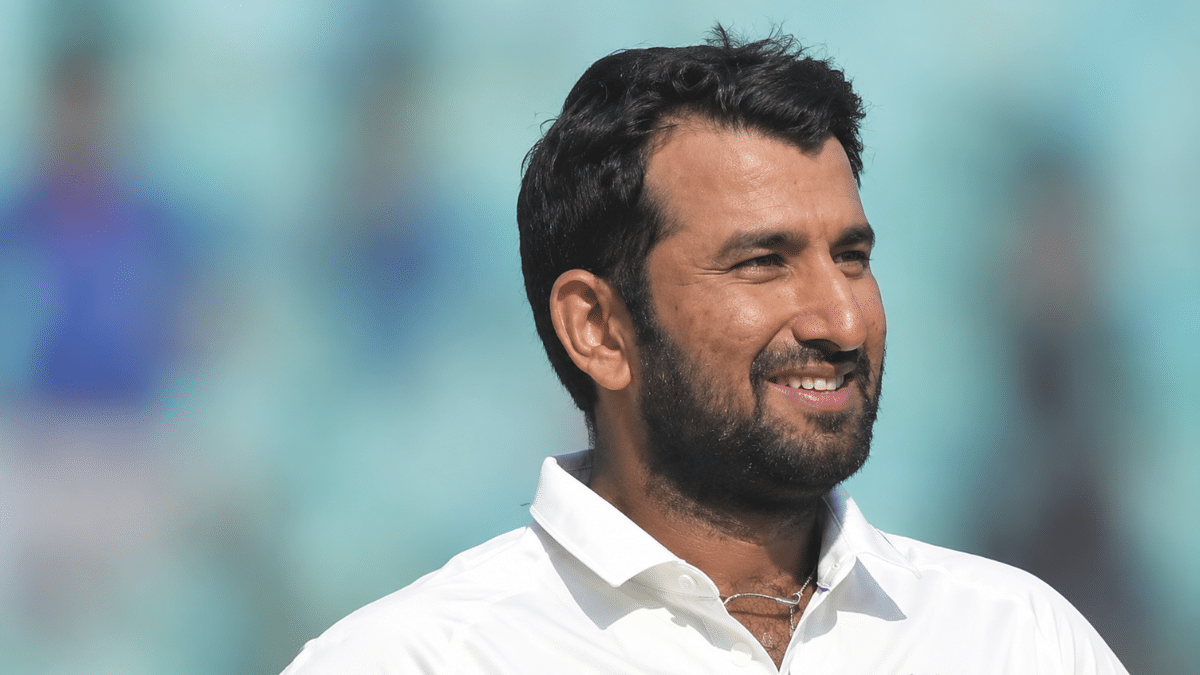
Cheteshwar Pujara has revealed that Australia had access to a live television feed in their dressing room during the 2016-17 Border-Gavaskar Trophy, using it to guide their DRS decisions.
Speaking on Aakash Chopra’s “Baith & Bol” podcast, Pujara said the advantage was obvious to anyone paying attention.
“Every time you looked at their DRS decisions, they were spot on. They knew whether they had to take it or not. Until then, none of us Indian players were aware that Australia had a live feed in their dressing room.”
Cheteshwar Pujara, Baith & Bol podcast, September 2026
Dressing room feeds are supposed to run on a delay. That delay exists specifically to prevent teams from using replays to influence on-field decisions. According to Pujara, Australia bypassed it.
“Normally, the dressing-room feed is delayed, but they had a live feed ready. So, they used to sneak a look towards the dressing room so that nobody would catch them, and then make the call on whether to take the DRS or not.”
Cheteshwar Pujara, Baith & Bol podcast, September 2026
View this post on Instagram
The practice came to light during the second Test in Bengaluru on March 7, 2017. Steve Smith, struck on the pad by Umesh Yadav, turned toward the Australian dressing room before deciding whether to review. Virat Kohli spotted it immediately and protested to the on-field umpires.
The umpires intervened. Smith was denied the review and dismissed LBW for 15. Australia, who were 4 down at that stage, collapsed. Their last six wickets fell for 38 runs. India won by 75 runs.
Smith addressed it in the post-match press conference that evening.
“It was a bit of a brain fade on my behalf and I shouldn’t have done that.”
Steve Smith, post-match press conference, Bengaluru, March 7, 2017
He explained that he had consulted non-striker Peter Handscomb first, then instinctively looked toward the viewing area. Handscomb later took responsibility on Twitter.
“I referred smudga to look at the box… my fault and was unaware of the rule. Shouldn’t take anything away from what was an amazing game!”
Peter Handscomb, Twitter, March 2017
Kohli was not buying the brainfade explanation. He said he had noticed Australian batters doing the same thing twice while he was batting earlier in the match.
“I saw that two times when I was batting…this falls under that bracket. I wouldn’t do something like this on the cricket field.”
Virat Kohli, post-match press conference, Bengaluru, March 7, 2017
Cricket Australia rejected the allegations, calling Kohli’s claims “outrageous.”
Pujara’s view, nine years later, is blunt.
“It was unfair in a way. You are searching for the loophole. If this was done by any other team, they would’ve objected.”
Cheteshwar Pujara, Baith & Bol podcast, September 2026
Insider Read
You notice it before anyone talks about it. When you are batting and the opposition reviews a decision, you develop a sense for how confident they look. Most teams guess. They argue at the crease, weigh it up, sometimes burn a review on instinct.
Australia in 2017 did not guess. Their reviews had a certainty that stood out. The batter would glance toward the dressing room, just a flick of the eyes, and then signal with total conviction. No debate, no hesitation. That kind of accuracy is not possible without information.
For the Indian players standing at the other end, the pattern was clear long before Bengaluru made it public. The brainfade did not create the problem. It exposed one that had been running through the series.
The BCCI filed a formal complaint with the ICC after the Bengaluru Test. The ICC declined to take action. The BCCI withdrew its complaint days later.
What changed was subtler. After the Bengaluru incident put the spotlight on Australia’s DRS process, their review success rate dropped noticeably for the remainder of the series. The certainty disappeared.
Smith’s “brainfade” became one of the defining moments of the 2016-17 Border-Gavaskar Trophy, a series India won 2-1. It resurfaced during the 2017-18 ball-tampering scandal in South Africa, where Smith was banned for 12 months alongside David Warner and Cameron Bancroft.
Pujara’s revelation does not change what happened. But it reframes it. The brainfade was not an isolated lapse in judgment by one player. It was the moment a system became visible.
Also Read: