
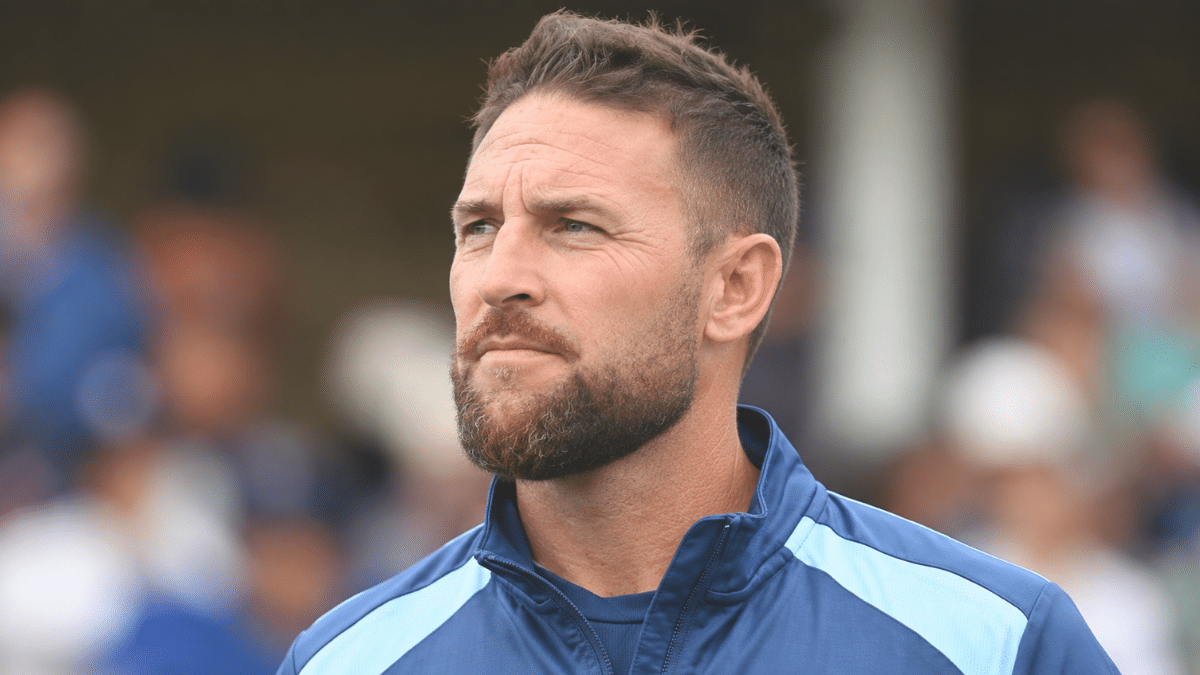
Brendon McCullum called Kevin Pietersen and asked if he wanted to work with England. Pietersen thought he was joking. A year ago, Pietersen was on television tearing England’s preparation apart. Now he sits inside the dressing room at Southampton, has addressed the full squad on discipline, and starts work today against Sri Lanka.
McCullum on Pietersen is a story about a coach who chose to bring his loudest critic inside rather than keep him at arm’s length. That choice says more about where England’s white-ball setup stands than the appointment itself.
During England’s 2025 tour of India, Pietersen publicly accused the squad of a relaxed training culture and questioned whether players were giving their all. McCullum rejected that criticism at the time as “factually incorrect.”
But when McCullum rang Pietersen months later, the tone was different. Pietersen raised it immediately.
“He mentioned that he has been quite critical of us in the past and I said, ‘I have no problem with that, mate’. Some of it’s fair and some of it would need some explanation, but I have no problem with that.”
Brendon McCullum, press conference, September 14, 2026
That is a significant shift. From public denial to private acknowledgement that parts of the criticism had merit.
McCullum has been specific about what Pietersen’s role is not. He is not a batting coach. He is not confined to one area.
“I don’t want him to be buried in one specific skillset. I want him to look across the set-up and challenge me privately on ways we can improve.”
Brendon McCullum, press conference, September 14, 2026
That language matters. “Challenge me privately” is not something coaches typically invite. McCullum is building an accountability structure into his own setup, something England’s white-ball programme lacked when it had no external voice willing to question methods.
Pietersen’s brief is to observe everything, from training standards to off-field discipline, and report back to McCullum directly. On his first day, he addressed the squad on professional responsibilities both on and off the field. He spent the morning in the nets, had an extended conversation with Ben Duckett, and watched Jos Buttler’s wicketkeeping drills.
The reasons McCullum gave for wanting Pietersen are telling. He did not talk about tactical knowledge or coaching qualifications. He talked about character.
“Kev was an unbelievable player and he was a winner. He was a guy who left no stone unturned in terms of his own preparation. He believed in himself in the big moments and more often than not he performed in those big moments. They are attributes we would love to rub off on our talented players that sit within the dressing room.”
Brendon McCullum, press conference, September 14, 2026
Preparation. Competitiveness. Belief in pressure moments. These are the exact areas England were accused of falling short in India. McCullum did not recruit Pietersen despite the criticism. He recruited him because of it. The qualities Pietersen attacked England for lacking are the qualities McCullum now wants him to install.
“He has brought a ton of energy to the set-up within the last 24 hours,” McCullum said. “His work ethic is second to none and when he is all in on something, he is all in.”
McCullum backs Pietersen to bring a winning mentality to England’s changing room 👊 pic.twitter.com/relRJrj8wA
— Cricinfo (@cricinfo) September 15, 2026
The Coach Who Recruits His Own Critic
In professional cricket, coaches protect their position. The instinct when a former player criticises your methods on television is to dismiss, distance, and move on. McCullum did the opposite. He picked up the phone.
That tells you he knows something needs to change in England’s white-ball environment ahead of the 2027 World Cup in South Africa, Zimbabwe and Namibia. Converting a public critic into a private challenger keeps the pressure but removes the damage. The real test comes the first time Pietersen disagrees on something during a live series, not in a studio, but face to face with the coach who invited him in.
The appointment carries a 12-year arc. In 2014, the ECB ended Pietersen’s international career. Andrew Strauss cited “a massive trust issue.” Strauss offered Pietersen a white-ball advisory role at the time. Pietersen declined.
Now, in 2026, Pietersen accepts almost the same position he once rejected. “I am going to put on the England uniform for the first time since 2014, and it is going to be a profound honour and deeply special moment,” Pietersen said. The role runs for 12 months through the 2027 World Cup. His South African upbringing gives him local knowledge of conditions England will face.
The Dynamic Question
Michael Vaughan raised the one concern no one else has publicly named. “I don’t see any other team in the world that has such a famous coaching set-up,” Vaughan said. “Baz McCullum, Kevin Pietersen, Stephen Fleming in the Test team, Marcus Trescothick. There’s some really big names.”
Vaughan was clear he was not calling it a bad thing. “In terms of knowledge and what he can pass on to the players, I have absolutely no doubt that he’ll do a really good job.” But the question remains: four large personalities, all former international players with strong opinions, operating inside one structure. Mark Ramprakash put it bluntly: “Either the smartest piece of man-management the ECB has done in years, or the fastest route to a very public row.”
McCullum is betting on the first outcome. “It’s healthy when you create an environment where you’re able to challenge,” he said. England’s white-ball World Cup campaign now depends on whether that belief holds when the challenges start coming from inside the room.
Also Read: